
The Website Mistake 95% of Interior Designer's Make and How to Fix it.

Updated: Feb 19
You’ve planned your website. You’ve written your copy — maybe yourself or with a designer’s help. You’ve edited photos, tweaked layouts, and polished every detail. Then you hit publish, clicked “launch,” and waited for the calls to start rolling in.
But… nothing much happens.
The good news is that there’s a single step most people miss that can dramatically improve your chances of being found online— an in a timely manner.
Today we’re going deep on the number one mistake interior designers make when launching their website: not submitting it to Google Search Console for indexing — and why that matters for being found online, clicks, and bookings.

What “Indexing Your Website" Means
Google doesn’t automatically know about every new website that goes live. Thousands of websites go live everyday. It uses programs called crawlers to explore the internet and add sites to its index — the listing of pages Google knows about. Once a page is in the index, Google can show that page in search results. If the website is not in the index, it can’t show the website—it simply doesn't know it's there. It’s that simple.
Here’s the key:
your website WON'T show up in Google Search unless Google has indexed it first.
Submitting your site to Google Search Console is how you officially tell Google:
“Hey! This website exists. Here are my pages. Please crawl and index them so they can appear in search results.”

Think of Google as a gigantic library, and each website is a book on its shelves.
You wrote an amazing book — with beautiful pages, compelling content, and valuable insights. But when you published it, you just slipped it onto a shelf without telling the librarian. No title card. No catalog entry. Nothing.
So when someone asked the librarian for books on interior design services in Chicago, the librarian would shrug because your book isn’t listed.
This is exactly what happens when you skip submitting your site to Google Search Console: Google simply isn’t sure your pages exist or what they’re about, so it can’t recommend them to the people searching for exactly what you offer.
Why Interior Designers Often Miss This Website Step
There are a few reasons:
Most website platforms don’t automatically submit your site for indexing.
Many designers and business owners assume that “if it’s live on the web, Google will find it.”
Google’s own SEO guides assume you’ll check indexing status.
The truth is that many interior designers — likely more than 90% or 95% — launch their website without submitting a sitemap or individual pages to Google Search Console for indexing. That means Google may not fully know what’s on your site or even that it exists — even weeks or months later.
What Happens When You Don’t Submit for Indexing
If you don’t submit your sitemap or URLs to Google Search Console:
Google might not discover every page on your site
Important service pages could be missed
Your blog posts might not show up in search
Google might take longer to crawl your site
Worst of all, Google may never fully index your site — meaning it could remain mostly invisible in search results even weeks after launch.

Why Google Search Visibility Matters
Before we go further into the how-to, let’s talk about why this matters.
Today, search traffic is still a cornerstone of building a business without Instagram burnout. A strong presence in Google search results puts your services in front of people actively looking for them, not just scrolling social media hoping they’ll discover you.
According to a Forbes Advisor report, having a strong online presence and visibility on Google is critical to business growth and reaching your audience. Perspection is that business that do not show up in Google feel "less legitimate."
That means:
People searching for “interior designer [your city]” could find you
People seeking help with a remodel could discover your portfolio
People looking for design inspiration could land on your blog and stay in your ecosystem
But none of that can happen unless Google knows your website exists and understands its structure.
What Google Search Console Does and How It Can Help Your Business
Google Search Console (GSC) is a free tool from Google that helps website owners monitor and manage their site’s presence in Google Search.
It lets you:
• See whether Google has indexed your pages
If a page hasn’t been indexed, it won’t show up in search. You can check indexed pages directly inside GSC.
• Submit your sitemap
A sitemap is like a map of your website — it shows Google where all your important pages are. Submitting your sitemap makes it much easier for Google to discover and index your pages.
• Request indexing for new or updated content
If you add a new page or make significant changes, you can tell Google to crawl that page now — rather than waiting for Google’s crawler to find it on its own. I recommend submitting your page for indexing AFTER EVERY UPDATE or tweak.
• Get alerts about errors or issues
GSC can show you crawl errors, mobile usability issues, security problems, and other things that could prevent your site from performing well in search.
• See the actual traffic and visibility your website is getting
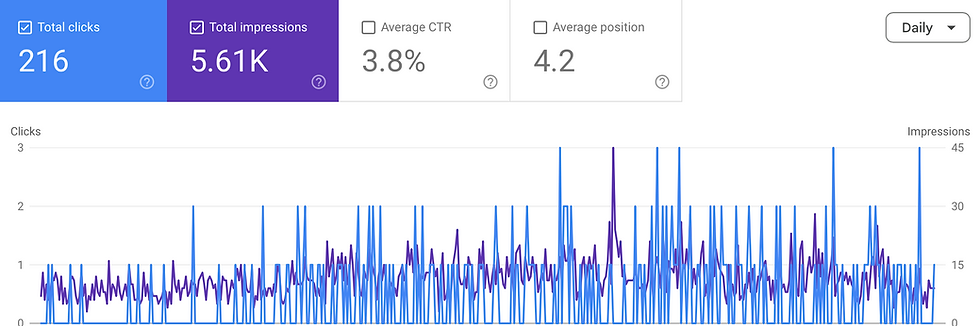
GSC will show you how many times your website showed up in a result (called "impressions"), how many times someone clicked on your site, and even what keywords you are ranking for. If you are only looking at the analytics of your website builder (Wix, Squarespace, Showit) and not Google Search Console, you are only getting a partial picture. They will tell you how many people went to your website, but NOT how many times you showed up in search results.
If your website is getting 2,000 impressions, but nobody is clicking on it, then you know that your "Click Through Rate" is low, and that is what you need to work on.
By checking the keywords you are ranking for, you may see that you are ranking for keywords that are not relevant to the search. For example, if your interior design business specializes in kitchen designs, but you are actually ranking in search results for family room remodeling, your website isn't being shown to the right people.
All of those capabilities help Google understand your site better and helps you understand your website performance.
According to Forbes, "SEO isn’t just buzzwords — it’s the strategy that makes your content discoverable and visible in search rankings, and tools like Search Console help you monitor and optimize that visibility. Indexed pages are eligible to rank and appear in search — without indexing, SEO can’t work." — Forbes
How to Submit Your Site to Google Search Console (Step-by-Step)
Before you start, you need to know where your domain (URL) is hosted, which isn’t always the same place your website is built. For example, your domain might be registered with GoDaddy, while your site is built on Wix, Squarespace, or Showit—or everything might live in one place.
1. Go to Google Search Console
Visit search.google.com/search-console and click Start Now.
2. Add your website as a property
On the left column, click Add Property.
From here, Google will ask you to verify that you actually own your website—this is the step where most people get stuck.
3. Verify your site
Google will give you a verification code and ask you to add it to your domain settings as a DNS (specifically a CNAME) record. This is simply a way for Google to confirm, “Yes, this person owns this website.” 4. Add DNS record to your URL Domain You’ll copy the code Google provides, log into your domain host (like GoDaddy), go to your DNS (domain settings), and paste the code into a new CNAME record. Once that’s saved, Google can verify your site and unlock all the Search Console data for you.
And here’s the exact AI prompt you can use if you get stuck at the DNS step:
AI Prompt: “I want to verify my website with Google Search Console. My website is built on [Wix / Squarespace / Showit], and my domain is hosted with [GoDaddy / Namecheap / Google Domains]. Google gave me a CNAME record to add for verification. Can you give me step-by-step instructions for exactly where to click and what to add in my domain settings?”
5. Request indexing for all pages
Once your domain is verified, use the URL Inspection Tool on left to enter each website page and click “Request Indexing.”
That’s it! Once this is done, Google will start discovering and indexing your content
and your pages become eligible to show up in search results. Repeat on every update or change to your website, so Google has the latest and greatest.
When Should You Submit it to Google Search Console?
Now.
Seriously, if you haven't done this before, now is the time.
Ideally, you submit your sitemap and indexing request as soon as your site is live. But it’s never too late.
Whether your site launched yesterday, last month, or even a year ago, you can still submit your sitemap and URLs today. Google will crawl your site again and begin indexing pages.
It Is Essential in order to show up in Search Results
Submitting your website to Google Search Console doesn’t guarantee instant rankings or page one results — no tool can do that. But it is a foundational step every business owner should take to ensure their site has the ability to show up on Google Search Results.
And as search continues to evolve, visibility on Google remains a strategic advantage. According to Forbes, SEO — which includes practices like indexing — should be the foundation of your web presence because it drives real, measurable visibility.
If your pages don’t get crawled and indexed in that database, they cannot show up in search results, no matter how good your content is. Being in the index is a prerequisite to search visibility and traffic — indexing is the first step before any ranking can happen. — Forbes
Beyond Indexing: What This Step Unlocks
Once your site is indexed:
You can monitor how people find you via search
You can see which keywords bring impressions
You can optimize pages based on performance trends
You can catch errors before they hamper visibility
All of these insights come directly from Google Search Console — the same system Google uses to understand your site.

The Bottom Line
Launching your website is exciting, but that excitement can stall if nobody can find it.
A business grows, needs to be found first. Submitting your site to Google Search Console only takes a few minutes, but it unlocks the foundation of search visibility. It ensures Google knows:
your pages exist
what they’re about
and how they’re connected
Without that step, your site could remain largely invisible to exactly the people you want to reach.
If you want more guidance on how to use this tool, interpret the data, and grow your organic visibility, I teach this in depth inside The SEO-Powered Website™, where you learn everything you need to know about getting your website top in search results and AI overviews, simplifying your marketing and growing your business.
Having an interior design business that works for you, allows you the time to work on projects, have a work/life balance and grow sustainably—without burnout— starts with an SEO-powered website.
The SEO Course for Interior Designers— The SEO-Powered Website™
— Melanie (Mel) Zaelich is an award-winning interior designer, branding strategist, and SEO educator dedicated to helping fellow designers build wildly successful businesses—without the stress of marketing. Learn more about Melanie.


Comments